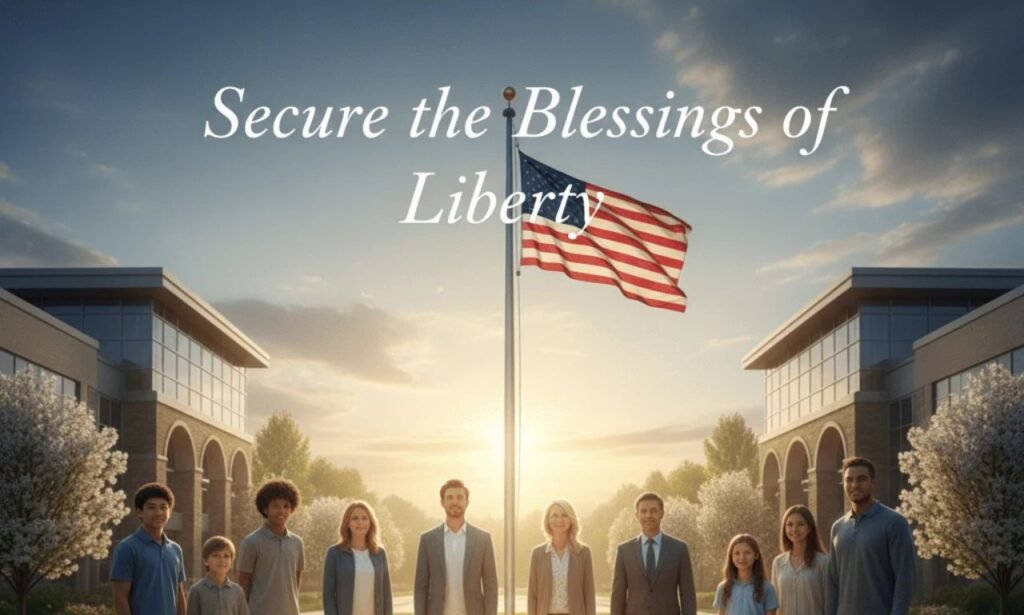
When the Founding Fathers drafted the Preamble, they wanted to ensure that individual rights were protected by a fair government. This is why understanding the secure the blessings of liberty meaning is so vital for every American citizen today. It represents a legal commitment to preserve personal freedom, justice, and opportunity for both the current population and all the future generations to come.
Imagine a world where your basic rights could be taken away at any moment without a fair trial. That is exactly what the U.S. Constitution was designed to prevent by establishing checks and balances. This foundational document serves as a shield, ensuring that democracy remains strong and that autocracy never takes root in our society.
By protecting our civil liberties, the government allows us to chase our dreams and live in peace. This intergenerational contract means we must stay vigilant to keep these constitutional protections alive. It is our civic duty to honor this historical mandate through 2026 and beyond.
What Does “Secure the Blessings of Liberty” Mean?
To truly grasp the secure the blessings of liberty meaning, one must look at the word “secure” as an active verb. In the context of the late 18th century, to secure something was to make it fast, stable, and protected from external interference. The Founders recognized that while liberty might be a natural right, it is also a fragile one. Without a structured government to act as a guardian, the “blessings”—the benefits and joys of being free—could easily be trampled by the strongest or most influential members of society.
In 2026, this phrase remains a promise that the American government exists to protect the autonomy of the individual. It suggests that freedom is not a gift from the state, but a “blessing” inherent to humanity that the state is hired to protect. When we speak of this meaning today, we refer to a comprehensive shield that covers our speech, our property, our privacy, and our right to pursue a life of our own choosing without arbitrary overreach.
Understanding the Preamble and Its Purpose
The Preamble is the introductory statement of the U.S. Constitution, acting as a mission statement for the nation. It does not grant specific legal powers like the subsequent Articles do, but it sets the “intent of the Framers.” It explains that the document was created by “We the People” to form a more perfect union. By placing the goal of liberty at the end of the Preamble’s list of objectives, the Founders highlighted it as the ultimate result of a functional government.
The purpose of the Preamble is to provide a moral and logical justification for the laws that follow. It establishes that the government’s legitimacy comes from its ability to provide justice, tranquility, and defense, all of which are prerequisites for a free society. In the modern era of 2026, the Preamble serves as a reminder to legislators and citizens alike that any law passed should ideally serve one of these six core goals, with the preservation of liberty being the most vital.
The Meaning of “Blessings of Liberty”
The “blessings of liberty” refer to the positive outcomes and opportunities that arise when a person is free from oppression. These are not just abstract ideas; they are the practical realities of daily life. The Founders viewed these blessings as a divine or natural inheritance that allows a society to flourish.
To better understand these “blessings,” consider the following categories:
- Intellectual Blessings: The freedom to think, read, and share ideas without censorship.
- Economic Blessings: The right to own property, enter into contracts, and enjoy the fruits of one’s labor.
- Spiritual Blessings: The ability to practice a religion—or no religion at all—according to the dictates of one’s conscience.
- Political Blessings: The right to vote, petition the government, and run for office.
These blessings create an environment where innovation and personal growth can occur. When the state secures these rights, it allows for a “blessed” state of existence where fear of the government is replaced by participation in it.
To Ourselves and Our Posterity: What It Really Means
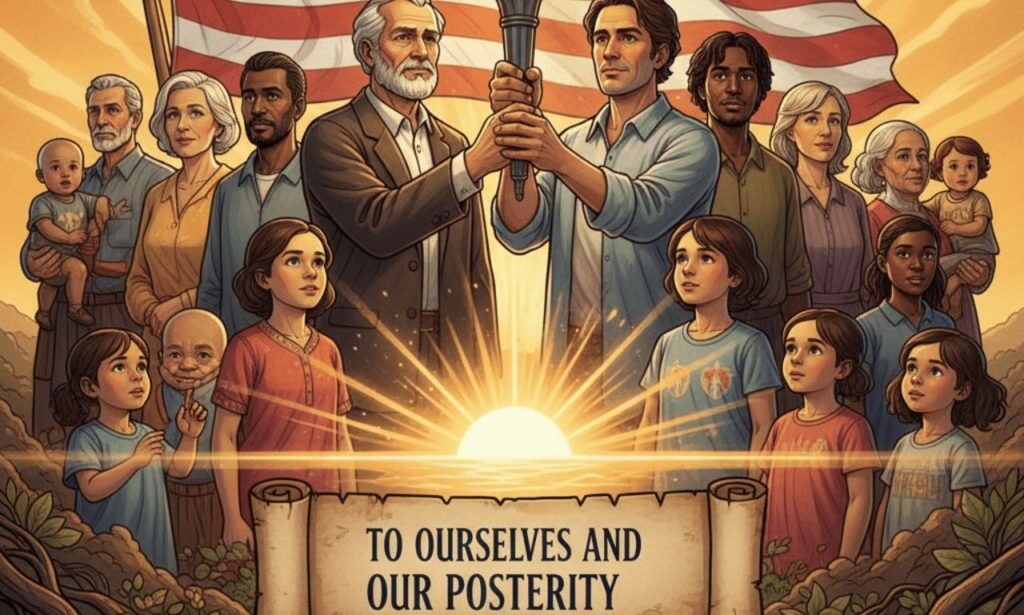
The phrase “to ourselves and our posterity” is perhaps the most selfless part of the Constitution. “Posterity” refers to all future generations—our children, grandchildren, and those yet to be born. By including this, the Framers acknowledged that they were not just building a government for their own immediate comfort, but a durable “house of freedom” that could stand for centuries.
This creates an intergenerational contract. It implies that every generation has a “usufruct” right to liberty—they can enjoy it, but they have a duty not to waste or destroy it for the next generation. In 2026, this is often discussed in terms of national debt and environmental health; if we leave the next generation with a bankrupt or unlivable nation, we have failed to secure the blessings of liberty for our posterity. It is a reminder that freedom is a relay race, not a sprint.
What Does Liberty Mean in the Preamble?
In the context of the Preamble, liberty is defined as “ordered liberty.” This is a crucial distinction from “license,” which is the ability to do anything one wants regardless of the harm caused to others. Liberty in the American sense is the freedom to act within a framework of laws that protect everyone’s rights equally.
The definition of liberty has expanded significantly since the 18th century. Originally, it was largely seen as freedom from government interference. By 2026, the interpretation often includes the “freedom to” participate fully in society. This includes:
- Civil Liberty: Protection from arbitrary arrest and the right to a fair trial.
- Personal Liberty: The right to move freely and make personal life choices.
- Digital Liberty: A modern concept involving the right to be forgotten and the right to encrypted communication.
The Founders’ Vision: Securing Freedom for All
The Founders’ vision was rooted in the Enlightenment, specifically the ideas of thinkers like John Locke and Montesquieu. They believed that because humans are fallible, no single person should have absolute power. Their vision of securing freedom relied on the concept of “fracturing” power so that it could never be used to crush the individual.
While the original implementation of this vision was tragically incomplete—excluding many based on race and gender—the framework they built was designed to be self-correcting. The “vision” was a society where the law is king, rather than a king being the law. They envisioned a marketplace of ideas where the best solutions for the country would rise to the top through debate rather than force.
How the Government Works to Secure the Blessings of Liberty
The government secures liberty through a system of “check and balances” across three branches. Each branch has a specific role in ensuring that no part of the government becomes a threat to the people’s freedom.
The following table outlines how these branches interact to protect your rights:
| Branch | Mechanism of Security | Modern Application (2026) |
| Legislative | Writing laws that protect civil rights. | Passing data privacy acts to stop surveillance. |
| Executive | Enforcing laws and defending the borders. | Protecting citizens from foreign cyber threats. |
| Judicial | Striking down unconstitutional laws. | Ensuring that AI-driven policing respects due process. |
This table shows that the security of liberty is a constant process of tension and adjustment. If the Executive branch overreaches, the Judicial branch steps in. If the Courts drift too far from the public will, the Legislative branch can propose amendments. This friction is what keeps the “blessings” safe from any single point of failure.
Examples of Securing the Blessings of Liberty in Everyday Life
Securing liberty is not just something that happens in high-profile courtrooms; it manifests in the mundane aspects of daily life. These examples show how the constitutional promise translates to our lived experience.
Consider these everyday scenarios:
- The Right to Privacy: When you close your curtains or lock your digital devices with a passcode, you are exercising a liberty that the government is restricted from violating without a warrant.
- Freedom of Assembly: When a neighborhood group meets in a public park to protest a local zoning law, the government’s role is to protect their right to meet, not to silence them.
- Due Process: If you receive a traffic ticket, you have the right to a hearing. This “blessing” ensures that the state cannot take your property (money) without a fair procedure.
- Freedom of the Press: Journalists can investigate government corruption in 2026 without fear of being jailed by the subjects of their investigation.
The Responsibility of Citizens in Preserving Liberty
Liberty is not a “set it and forget it” system. It requires an active and informed citizenry. If the people stop paying attention, the mechanisms of government can be redirected toward the interests of the powerful rather than the security of the many.
Citizens hold several key responsibilities to ensure liberty survives:
- Educated Voting: Understanding the issues and the records of candidates.
- Civic Participation: Serving on juries, attending town halls, and staying informed.
- Respecting Others’ Rights: Liberty cannot exist for you if it does not exist for your neighbor. This requires a level of social tolerance.
- Vigilance: Questioning government actions and demanding transparency.
Securing the blessings of liberty meaning includes the idea that the “People” are the final check in the system of checks and balances.
The Connection Between Liberty and Justice
There is a profound connection between liberty and justice; you cannot have one without the other. Without justice, liberty is merely the “right of the strongest” (anarchy). Without liberty, justice is merely “compliance with the state” (tyranny). The Constitution links them by ensuring that the law applies equally to everyone.
Justice acts as the guardrail for liberty. It ensures that when one person’s exercise of “freedom” infringes upon another’s, there is a fair way to resolve the conflict. For example, your liberty to swing your fist ends where another person’s nose begins. The judicial system provides the “justice” that allows everyone to live in a state of “liberty” simultaneously without constant conflict.
Why “Secure the Blessings of Liberty” Still Matters Today
As we move through 2026, some might ask if a phrase from 1787 is still relevant. The answer is found in the new challenges of the 21st century. In an age of mass data, global surveillance, and rapid technological change, the “blessings of liberty” are under constant pressure.
Securing liberty today means:
- Algorithmic Fairness: Ensuring that AI systems do not reinforce bias or take away opportunities.
- Information Integrity: Protecting the “blessing” of a free press from the “curse” of state-sponsored disinformation.
- Personal Autonomy: Maintaining the right to make medical and personal decisions in an increasingly regulated world.
The phrase still matters because the human desire for self-determination is universal and timeless. The Preamble remains our best defense against the “creeping” loss of rights that occurs when a society prioritizes short-term convenience over long-term freedom.
Conclusion
In 2026, the mission to uphold the constitutional framework established by our Founding Fathers remains a perpetual task for every American citizen. It requires the coordination of three branches of government, the vigilance of millions of people, and a deep respect for the legal traditions that have sustained our republic for centuries. As we navigate new challenges in the digital age, we must remember that while the threats to our civil liberties may evolve, the core principles of justice and personal freedom stay the same.
By maintaining a system of checks and balances, adhering to the Rule of Law, and honoring our commitment to posterity, we ensure that the blessings of our ancestors remain available to our descendants. The U.S. Constitution is not a static relic of the past; it is a living shield that we must continue to strengthen through civic participation and social responsibility. Protecting our individual rights today is the only way to guarantee a stable democracy for the generations that follow.
